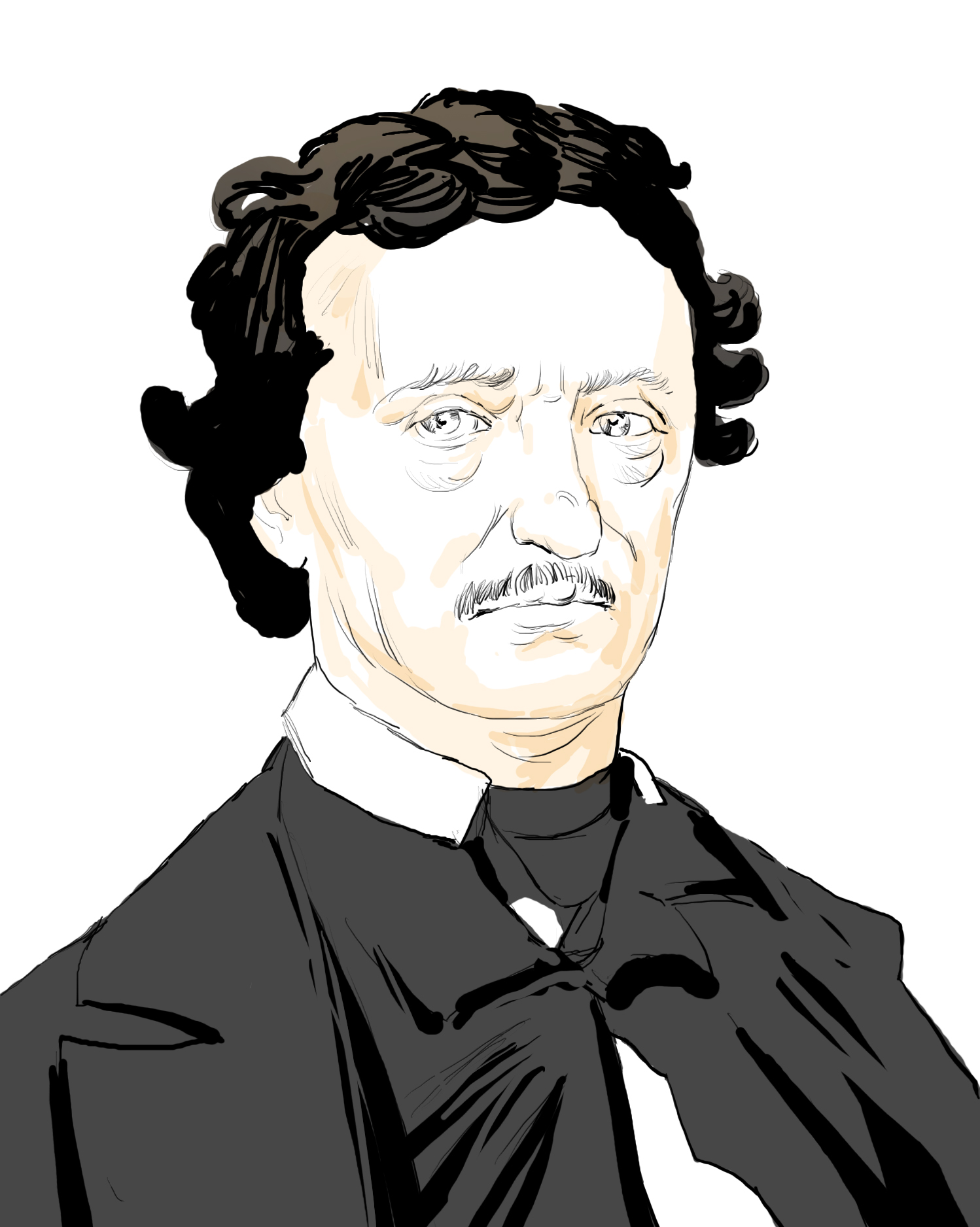
Edgar Allan Poe invented the detective story, wrote the most recognisable poem in American literature, and died at forty in a Baltimore street in circumstances that have never been explained.
He is also the writer whose posthumous reputation was most thoroughly poisoned. The first biography of Poe was written by Rufus Griswold, a literary rival who hated him, appointed himself Poe's literary executor, and set about inventing a drug-addled degenerate. That portrait stuck for a century, and it still contaminates almost everything written about Poe's mental health — so it is worth separating what is documented from what was manufactured.
Quick facts
- Born
- January 19, 1809, Boston, Massachusetts
- Died
- October 7, 1849, Baltimore, aged 40
- Known for
- "The Raven", "The Tell-Tale Heart", and the invention of detective fiction
- Diagnosis
- None — retrospective; complicated by alcohol and by hostile early biography
- Note
- Much of what people 'know' about Poe comes from a character assassination by his literary rival
Losses
Poe's life began with abandonment and did not let up. His father left before he was two; his mother, an actress, died of tuberculosis when he was not yet three. He was taken in, though never formally adopted, by John Allan, a Richmond merchant whose relationship with him would sour into permanent estrangement over money and debt.
He attended the University of Virginia for a year, gambling and drinking his way into debts Allan refused to cover, then enlisted in the army under a false name, then was deliberately court-martialled out of West Point when Allan cut him off entirely.
In 1836 he married his first cousin Virginia Clemm, who was thirteen. She contracted tuberculosis in 1842 and died in 1847 after five years during which she repeatedly seemed to recover and then relapsed. Poe described that period — the cycle of hope and collapse, repeated over years — as the thing that broke him, and he was explicit that his drinking was a response to it.
Productivity and Collapse
The pattern that leads people to suspect a mood disorder is well attested by his editors, employers and correspondents.
In his working phases Poe was formidable: prolific, disciplined, ferociously clever. He wrote at speed, edited magazines competently, and produced criticism so sharp it made him enemies across American letters. "The Raven" made him nationally famous in 1845, and he wrote it during one such phase.
Then he would come apart. He lost job after job at magazines — the Southern Literary Messenger, Burton's, Graham's — not for lack of talent but through episodes of drinking, erratic behaviour, and periods when he simply could not function. Between these he wrote letters of extraordinary self-loathing and despair, and at least one documented suicide attempt occurred in 1848, the year after Virginia's death.
He was also, by several accounts, dramatically intolerant of alcohol — contemporaries described a single drink producing effects that in another man would have taken a bottle. That detail matters, because it complicates the standard picture of Poe as a habitual drunk.
So Was Poe Bipolar?
The honest position is that Poe is a plausible but unprovable case, and considerably murkier than Virginia Woolf's.
In favour: documented alternation between highly productive, energetic, socially combative periods and episodes of incapacity and profound depression, across two decades, reported by many independent observers.
Against, or at least complicating: alcohol. Heavy episodic drinking produces exactly this pattern on its own, and Poe's apparent sensitivity to alcohol makes the confound worse rather than better. His life also contained enough genuine catastrophe — orphaned, disinherited, chronically poor, and watching his young wife die slowly over five years — to account for profound depression without invoking any illness at all. And the source base is contaminated by Griswold, who fabricated letters and invented incidents specifically to make Poe look deranged.
Various retrospective diagnoses have been proposed over the years, including bipolar disorder, alcoholism, epilepsy, a brain tumour, and rabies. The fact that the list is that long is itself the finding.
Baltimore, 1849
On 3 October 1849, Poe was found on a Baltimore street, delirious, in clothes that were not his, and unable to explain what had happened to him. He was taken to hospital, never became coherent enough to give an account, and died four days later at the age of forty.
His medical records and death certificate have been lost. Every explanation offered since — alcohol, rabies, cooping (being seized by an electoral gang, drugged and forced to vote repeatedly), a brain lesion — is inference. The most honest statement is that nobody knows how Edgar Allan Poe died.
Griswold's obituary appeared almost immediately under a pseudonym and set about destroying him. It worked for the better part of a century.
Legacy
Poe invented the detective story with "The Murders in the Rue Morgue" in 1841, and every fictional detective since is downstream of Dupin. He shaped the modern horror story, wrote significant early science fiction, and produced criticism that helped establish American literature as something distinct from a British province. The French Symbolists, particularly Baudelaire, treated him as a major figure long before American critics caught up.
For this website, Poe's case is a caution rather than an example. He is listed everywhere as a bipolar writer, usually with total confidence, on evidence that would not survive ten minutes of scrutiny — and much of it traceable to a man who was deliberately lying about him. Poe deserves better than to be diagnosed by people repeating his enemy.
Frequently Asked Questions
Was Edgar Allan Poe bipolar?
There is no diagnosis and the evidence is genuinely ambiguous. Contemporaries described alternating periods of intense productivity and complete collapse, which is consistent with a mood disorder, but heavy episodic drinking and repeated real-life catastrophe explain the same pattern. Poe remains a plausible but unproven case.
How did Edgar Allan Poe die?
Nobody knows. He was found delirious on a Baltimore street on 3 October 1849, wearing clothes that were not his, and died four days later without becoming coherent. His medical records and death certificate are lost. Proposed explanations include alcohol, rabies, a brain lesion and electoral 'cooping', none of which can be confirmed.
Why is Poe's reputation for madness unreliable?
His first biographer, Rufus Griswold, was a literary rival who despised him, made himself Poe's literary executor after his death, and deliberately fabricated material to portray him as a degenerate. That invented portrait dominated Poe biography for roughly a century and still colours popular accounts of his mental health.
Notes & sources
This article draws on Poe's surviving correspondence, accounts by his editors and contemporaries, and modern scholarship on the Griswold memoir and its influence on Poe biography. Claims about Poe's mental health are presented as contested because they are.