Mark Twain is on almost every list of famous people with bipolar disorder, and it is worth examining why, because the case is more interesting and more doubtful than the lists suggest.
What is not in doubt is the shape of his life: enormous, restless energy; a compulsion to chase schemes and inventions that repeatedly ruined him; a lecture circuit he worked like a man who could not stop; and long, black depressions in his later years, arriving after a run of bereavements that would have flattened anyone.
Quick facts
- Born
- Samuel Langhorne Clemens, November 30, 1835, Florida, Missouri
- Died
- April 21, 1910, Redding, Connecticut, aged 74
- Known for
- Adventures of Huckleberry Finn, Tom Sawyer, and inventing an American voice
- Diagnosis
- None — retrospective, and contested
- Complicating factor
- Extraordinary bereavement: he outlived his wife and three of his four children
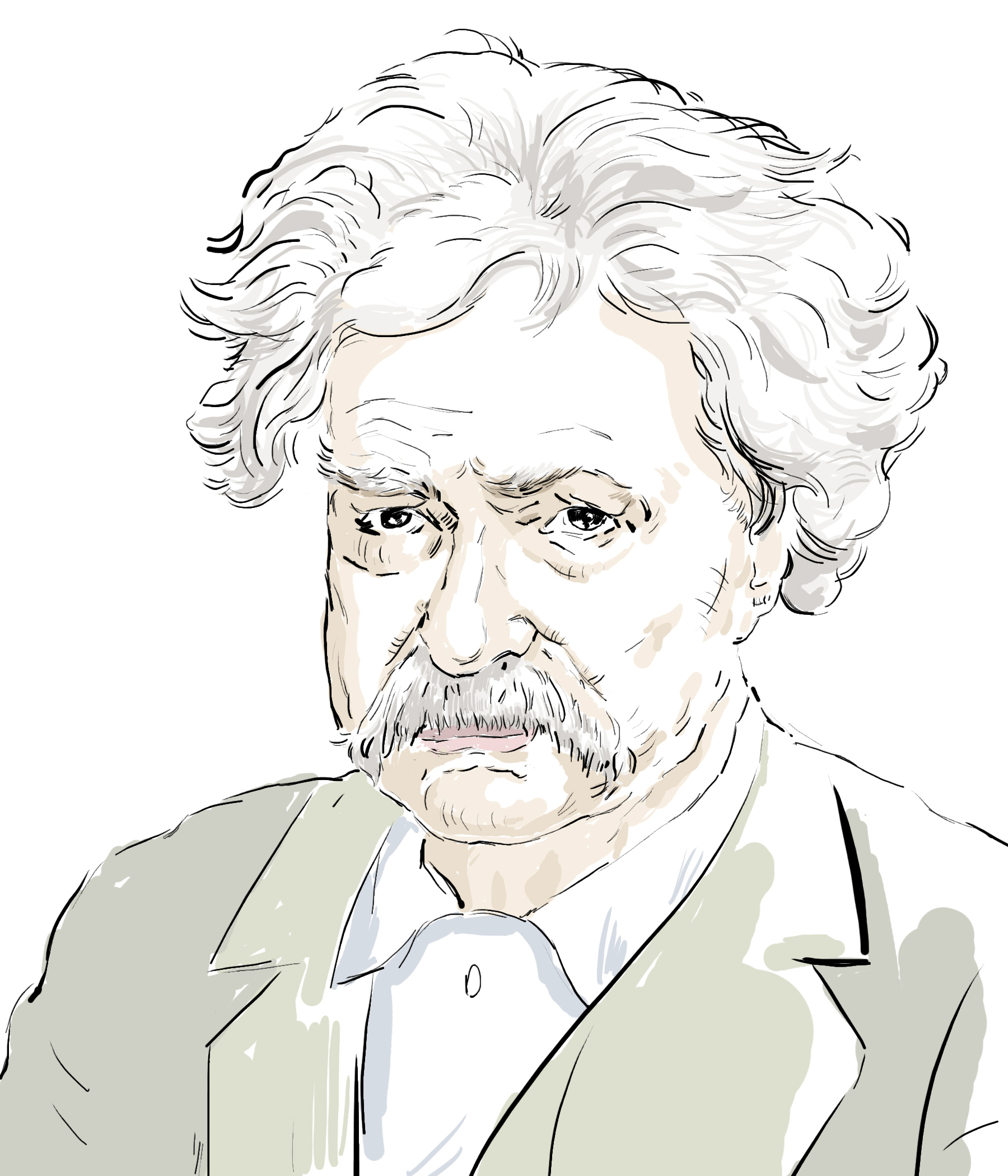
The River
Samuel Clemens was born in Missouri in 1835 and raised in Hannibal on the Mississippi, the town that became St Petersburg in his fiction. His father died when he was eleven; he left school and was apprenticed to a printer.
He became a licensed riverboat pilot — the job he said he loved above all others, and the source of his pen name — until the Civil War closed the river. Then came a brief, farcical stint in a Confederate militia, silver prospecting in Nevada, newspaper work, and in 1865 "The Celebrated Jumping Frog of Calaveras County", which made him nationally known.
He married Olivia Langdon in 1870, and by all accounts loved her without complication for thirty-four years.
The Speculation Problem
The detail that most attracts retrospective diagnosis is Twain's relationship with money, and it is genuinely remarkable.
He was one of the highest-earning writers in the world and repeatedly bankrupted himself. He poured a fortune into the Paige typesetting machine, an over-engineered contraption that never worked commercially, and kept pouring after it was obvious. He invested in a steam generator, a magnetic telegraph, an engraving process, a health-food supplement, and a self-pasting scrapbook — the last of which, ironically, was the only one that made money. He founded a publishing house that went bankrupt.
By 1894 he was insolvent, at sixty, and went on a global lecture tour to pay creditors he was not legally obliged to repay. He repaid them in full.
Grandiose, poorly-judged financial risk-taking during elevated periods is a recognised feature of bipolar disorder, and Twain's pattern — conviction, enormous outlay, refusal to cut losses, repeated across decades — is why his name recurs. But it is worth noting the alternative reading: the nineteenth century was full of confident men who lost fortunes to inventions, and Twain was a professional optimist by temperament and trade.
The Losses
The depressions of Twain's later years are documented beyond dispute, and so are their causes.
His son Langdon died in infancy in 1872. His daughter Susy, whom he adored, died of meningitis in 1896 at twenty-four, while Twain was abroad on the lecture tour. His wife Olivia died in 1904. His daughter Jean died in 1909, the year before his own death. Of four children, one outlived him.
His late writing turned savage. The Mysterious Stranger, Letters from the Earth and the later essays are bleak, furious and often unpublishable in his lifetime — a public humorist writing privately about a meaningless universe and a contemptible species. He described periods of being unable to work and of profound blackness.
This is where the case gets difficult. A man who buries a wife and three children and then writes despairingly about the universe is not obviously ill. He may simply be correct about his circumstances.
So Was Mark Twain Bipolar?
We would call it unproven and probably overstated.
The elements that support it: lifelong high energy and restlessness, a compulsion toward grandiose schemes with poor judgement about risk, an enormous appetite for work and travel, and severe depressive periods.
The elements against it: every documented depressive episode has a clear and sufficient external cause, and the evidence for genuine manic episodes — as opposed to an energetic, optimistic, entrepreneurial temperament — is thin. Twain left an enormous written record, and it does not contain the kind of account of elevated states that we have for Woolf or for Jamison. What it contains is a man working extremely hard and being repeatedly wrong about investments.
He belongs on this list as a widely-claimed case that deserves a sceptical hearing, and we would rather say that than repeat the claim confidently.
Legacy
Hemingway's line, that all modern American literature comes from Huckleberry Finn, is an overstatement that keeps being roughly true. Twain took the American vernacular seriously as a literary instrument and wrote the book that made the country's central moral failure legible to itself.
The public figure — white suit, cigar, one-liners — was a construction, and Twain built it deliberately. The private man was funnier, angrier and much sadder, and knew perfectly well that the two did not match. He wrote once that the secret source of humour is not joy but sorrow, which is either the observation of a depressive or the best working definition of comedy anyone has managed.
Frequently Asked Questions
Was Mark Twain bipolar?
It is unproven and, in our view, probably overstated. He showed lifelong restless energy and a pattern of grandiose, badly-judged financial speculation, and he suffered severe depressions in later life. However, every documented depressive episode followed a major bereavement, and his voluminous writings contain little evidence of genuine manic episodes as distinct from an energetic and optimistic temperament.
What losses did Mark Twain suffer?
He outlived his wife Olivia and three of his four children: Langdon in infancy, Susy at twenty-four in 1896, and Jean in 1909. Only his daughter Clara survived him.
Did Mark Twain lose his money?
Repeatedly. He invested enormous sums in the Paige typesetting machine and other failed ventures, and his publishing house went bankrupt. Declared insolvent in 1894, he undertook a worldwide lecture tour at sixty and repaid his creditors in full despite having no legal obligation to do so.
Notes & sources
This article draws on Twain's autobiography and correspondence, published biographies, and documented accounts of his business ventures and family bereavements. No diagnosis of Twain exists; discussion of bipolar disorder in his case is retrospective and is presented here as contested.