Robert Downey Jr. appears on virtually every list of famous people with bipolar disorder. Reports of a diagnosis have circulated for decades and are widely repeated as fact.
What Downey himself has said is considerably more limited, and we think it is worth being careful here, because the thing that is exhaustively documented in his case is not bipolar disorder — it is one of the most severe substance addictions ever played out in public, and one of the most complete recoveries.
Quick facts
- Born
- Robert John Downey Jr., April 4, 1965, Manhattan, New York
- Known for
- Chaplin, Iron Man and the Marvel films, Oppenheimer (Oscar, 2024)
- Diagnosis
- Bipolar disorder has been widely reported; Downey has spoken of it only obliquely
- Documented
- Severe substance addiction from childhood; multiple arrests; prison, 1999–2000
- Sober since
- 2003
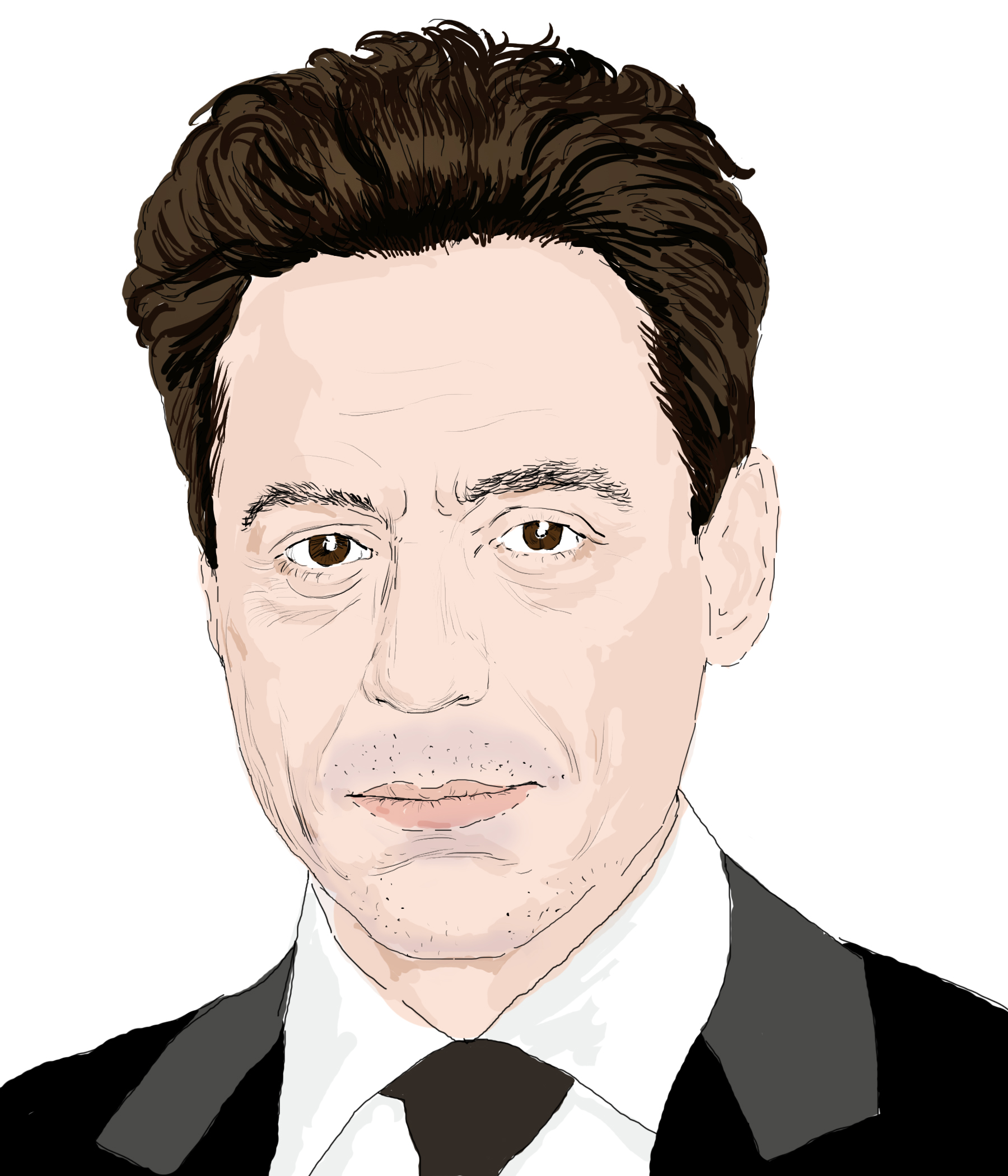
A Childhood With Drugs In It
Downey's father, Robert Downey Sr., was a countercultural filmmaker, and his son grew up on his sets. Downey Jr. has said, repeatedly and on the record, that his father gave him marijuana when he was six years old, and that drug use was simply part of the household — a way he and his father related to each other. Downey Sr. later expressed profound regret about this.
By his teens Downey was using regularly. His parents divorced; he moved between New York and California; he dropped out of high school.
He was also, obviously and immediately, one of the most talented actors of his generation. After a few years in the Brat Pack orbit he was nominated for an Academy Award at twenty-eight for Chaplin (1992), a performance that is still astonishing.
1996–2001
Then it fell apart with almost unbelievable speed.
In 1996 he was arrested after being found in a car with heroin, cocaine and a handgun. Weeks later he was found asleep in a neighbour's child's bed, having wandered in while intoxicated. There followed a series of arrests, missed court-ordered drug tests, and repeated stints in rehabilitation that did not hold.
He served roughly a year in California state prison from 1999 to 2000. He was released, joined Ally McBeal to considerable acclaim and a Golden Globe, and was arrested again within months. He was fired from the show and became, in the terminology of the industry, uninsurable — meaning no studio could finance a film he was in.
He was thirty-six, with an Oscar nomination, and unemployable.
His own comment on this period is among the most quoted things he has said: that it was like having a loaded gun in his mouth with his finger on the trigger, and that he liked the taste of gunmetal.
The Bipolar Question
Reports that Downey was diagnosed with bipolar disorder date from around this era, and have been repeated so often that they are generally treated as established.
What we can say with confidence: he has referred to being told he had a mood disorder and to being medicated during periods of his life, and he has spoken about the interaction between his psychological state and his drug use. What we have not found is a clear, direct, unambiguous statement from Downey confirming a bipolar diagnosis in the way that, say, Maurice Benard or Patty Duke did.
There is also a genuine clinical difficulty in his case that is worth naming rather than glossing. Distinguishing bipolar disorder from the mood effects of severe long-term stimulant and opiate use is extremely hard, and often impossible until someone has been sober for a sustained period. Downey was using heavily from childhood. Substance-induced mood episodes look very like primary mood episodes, and misdiagnosis in both directions is common.
Our position: bipolar disorder is plausible and widely reported, it is not confirmed by Downey in the way our other entries are, and his addiction is the thing that is unambiguously documented. We would rather say that than pad the claim.
2003 Onwards
Downey has been sober since 2003. He has credited a combination of things: a final decision made at a drive-through, a twelve-step programme, the martial art Wing Chun, his wife and producing partner Susan Downey, and a support structure he has maintained ever since.
The professional rehabilitation took years and required other people to take financial risks on him. Mel Gibson — also on this website — personally paid his insurance bond for The Singing Detective when no studio would. Joel Silver put his salary in escrow for Kiss Kiss Bang Bang. Jon Favreau fought Marvel to cast him as Tony Stark in Iron Man in 2008, against significant studio resistance.
That film made him, for roughly a decade, the highest-paid actor in the world and the anchor of the most commercially successful film franchise in history. In 2024 he won the Academy Award for Best Supporting Actor for Oppenheimer.
Legacy
Downey's comeback is the most complete in modern Hollywood history and is unlikely to be matched.
For readers of this website the useful lessons are not really about diagnosis. They are these: that the drugs and the mood problems were entangled for so long that even his own clinicians would have struggled to separate them; that recovery took him roughly a decade of failed attempts before it held; and that when it did hold, it required both his own sustained work and several specific people willing to take a risk on him.
That last part is the one most often left out of comeback stories, and it is the part most worth remembering.
Frequently Asked Questions
Does Robert Downey Jr. have bipolar disorder?
It has been widely reported for decades, and he has referred to having been told he had a mood disorder and to having been medicated. However, we have not found a clear, direct confirmation from Downey himself comparable to the public disclosures made by others. His severe substance addiction is far better documented, and separating the two is clinically very difficult.
How long was Robert Downey Jr. in prison?
He served approximately one year in California state prison between 1999 and 2000, following repeated drug arrests and missed court-ordered drug tests.
When did Robert Downey Jr. get sober?
He has been sober since 2003. His return to major studio work required others to guarantee his insurance, and Jon Favreau's insistence on casting him in Iron Man in 2008 completed the comeback.
Notes & sources
This article draws on interviews Robert Downey Jr. has given about his addiction and recovery, contemporaneous reporting of his arrests and imprisonment, and published accounts of his casting in The Singing Detective, Kiss Kiss Bang Bang and Iron Man. Reports of a bipolar diagnosis are presented as reports, because that is what they are.