Robin Williams appears on almost every list of famous people with bipolar disorder. He does not belong on any of them, and the real story is both more important and more useful.
Williams had depression, and he had a long history of addiction. But in his final year he was suffering from something nobody identified: diffuse Lewy body dementia. It was found only at autopsy, and the pathologist described it as among the most severe cases he had seen. During his life he had been told he had Parkinson's disease.
Quick facts
- Born
- July 21, 1951, Chicago, Illinois
- Died
- August 11, 2014, Paradise Cay, California, aged 63
- Known for
- Good Morning, Vietnam, Dead Poets Society, Good Will Hunting (Oscar)
- Diagnosis
- Never diagnosed bipolar. Diagnosed with Parkinson's in 2013 — incorrectly
- Autopsy finding
- Diffuse Lewy body dementia, one of the most severe cases on record
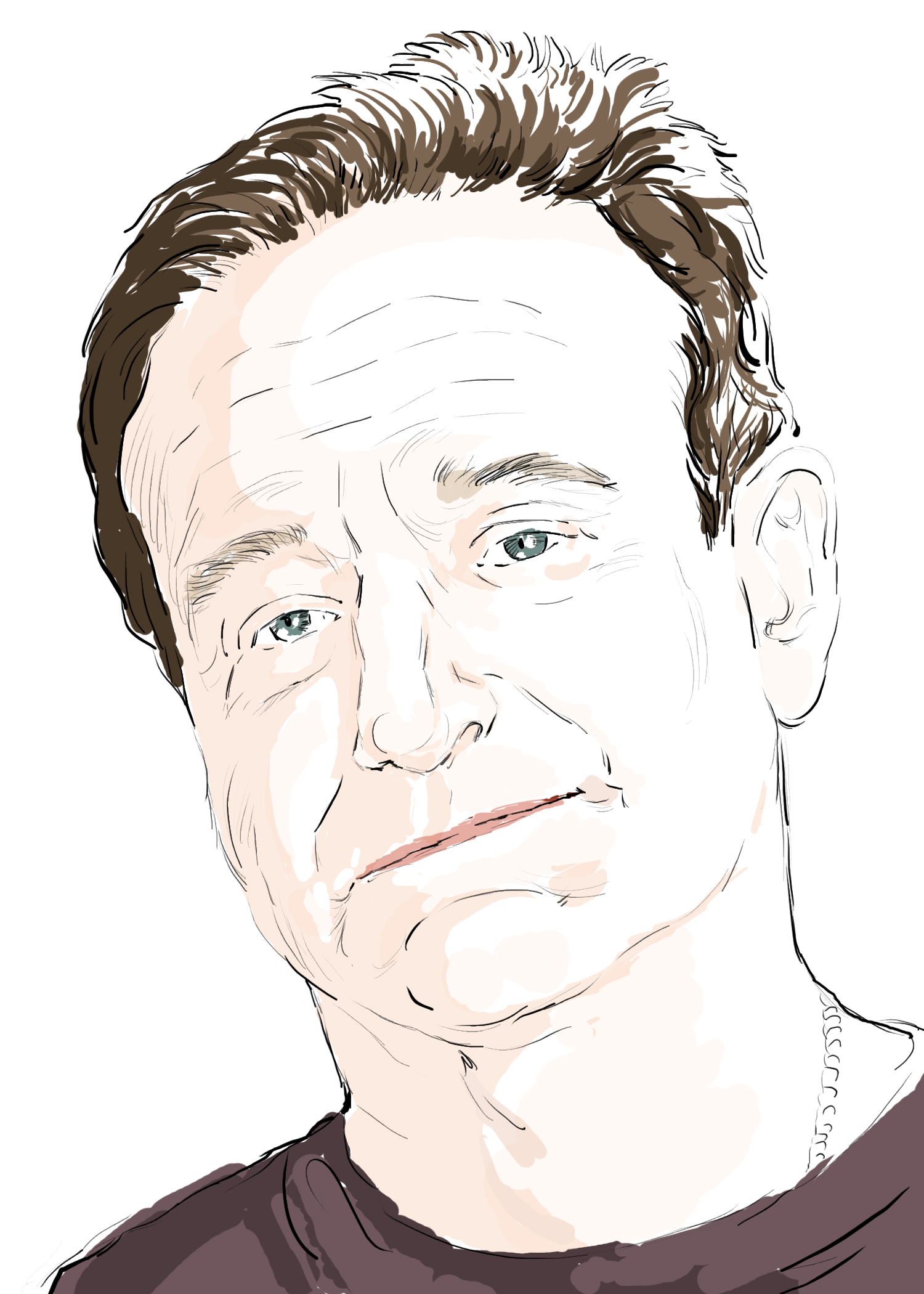
The Fastest Mind in the Room
Williams was born in Chicago in 1951 and grew up largely in Michigan and California, a shy and often solitary child who has said he made his mother laugh as a way of getting her attention. He studied at Juilliard under John Houseman, alongside Christopher Reeve, who became a lifelong friend.
Stand-up came first, and the improvisational speed he displayed on stage was genuinely without precedent — comedians who watched him in the late 1970s have described it as frightening. Mork & Mindy made him famous in 1978.
The film career that followed was extraordinarily varied: Good Morning, Vietnam, Dead Poets Society, Awakenings, The Fisher King, Aladdin, Mrs. Doubtfire, The Birdcage, and the Academy Award for Good Will Hunting in 1998.
Depression and Addiction
Williams was open about cocaine and alcohol addiction during the late 1970s and 1980s. The death of John Belushi in 1982 — Williams had been with him earlier that night — frightened him into sobriety, which he then maintained for two decades. He relapsed with alcohol in 2003 while filming in Alaska and entered rehabilitation in 2006, and again in 2014.
He also had depression, which he acknowledged. That is not in dispute and is not unusual.
What has never been established, anywhere, is bipolar disorder. Williams was never reported as diagnosed with it, never described manic episodes, and never spoke about mood-stabilising medication. The listing appears to derive entirely from his manic stage energy — which was a comic performance style he could switch on and off, and which he discussed as a craft rather than a state.
Confusing a comedian's performance register with a psychiatric symptom is precisely the kind of error this website tries not to make.
The Final Year
In late 2013 and through 2014, Williams began experiencing a bewildering array of symptoms. His wife Susan Schneider Williams has documented them in detail, including in a widely read medical journal article addressed to neurologists.
They began with insomnia, constipation, and a loss of his sense of smell. Then came extreme anxiety, tremors, paranoia, difficulty reasoning, and a collapse in his ability to remember lines — something that had never previously troubled him. On Night at the Museum: Secret of the Tomb he could not retain dialogue and was tormented by it, calling the director in the small hours in distress about his own performance.
He asked his doctors whether he was schizophrenic, whether he had Alzheimer's. In November 2013 he was diagnosed with Parkinson's disease and began treatment for its motor symptoms.
He died on 11 August 2014, aged sixty-three.
What the Autopsy Found
The brain autopsy found diffuse Lewy body dementia.
Lewy body dementia is caused by deposits of a protein called alpha-synuclein in the brain. In Parkinson's disease these are largely confined to the movement centres. In Williams' case they had spread throughout the cortex — the region governing thinking, perception and personality. The pathologist described it as one of the most severe cases of diffuse Lewy body dementia he had seen; a neurologist reviewing it said it was remarkable that Williams could walk at all.
This explains everything that had been baffling: the hallucinations, the paranoia, the fluctuating attention, the sleep disturbance, the collapse in reasoning, the anxiety that had no proportionate cause. These are textbook features of LBD, and they are routinely mistaken for psychiatric illness, Alzheimer's or Parkinson's, because the disease imitates all three.
Susan Schneider Williams has said that seeing the results brought a terrible clarity. Her husband had spent his last year being told, in effect, that he had a manageable movement disorder, while his entire brain was under attack.
Why This Page Exists
We could have quietly deleted Robin Williams from this website. We have kept him, with this headline, because the misinformation is so widespread that a correction is more useful than an absence.
Three things follow from his case, and all three matter to readers here.
Neurological disease imitates psychiatric illness. Lewy body dementia, brain tumours, thyroid disorders, autoimmune encephalitis and several other conditions can produce mood changes, hallucinations and personality shifts that look exactly like a primary mental illness. Anyone experiencing a genuinely new psychiatric presentation, particularly later in life and particularly alongside physical symptoms like tremor, sleep disturbance or loss of smell, deserves a thorough neurological workup.
Comedy is not a symptom. Being fast, funny and high-energy on stage is a skill, not a mood episode. Diagnosing performers from their performances is how this list got him in the first place.
The story people tell about him is wrong. The narrative of the sad clown whose depression finally caught up with him is neat, satisfying, and not what happened. What happened is that a man developed a devastating, rapidly progressing brain disease that nobody identified until it was too late.
If you're struggling, please reach out. Talk to a doctor, a mental health professional, or a crisis line in your country — and contact emergency services if you are in immediate danger.
Legacy
Williams left one of the most-loved bodies of work in modern film, and a reputation for personal generosity that has only grown since his death — the riders requiring productions to hire homeless people, the unpublicised hospital visits, the decades of Comic Relief.
His widow's advocacy has made Lewy body dementia dramatically better known among both the public and clinicians, and her account of his final year is now used in medical education. That is a real and specific legacy, and it belongs to him.
Frequently Asked Questions
Was Robin Williams bipolar?
No. There is no record of Robin Williams ever being diagnosed with bipolar disorder. He was open about depression and about addiction, but never described manic episodes or mood-stabilising treatment. He appears on bipolar lists largely because of his high-energy comedic performance style, which was a craft rather than a symptom.
What did Robin Williams actually have?
His autopsy revealed diffuse Lewy body dementia, described by the pathologist as one of the most severe cases he had seen, with Lewy bodies spread throughout the cortex rather than confined to the movement centres. During his lifetime he had been diagnosed with Parkinson's disease in 2013, which was incorrect.
What are the symptoms of Lewy body dementia?
They include progressive cognitive decline, well-formed visual hallucinations, fluctuating attention and alertness, REM sleep disturbance, parkinsonian movement symptoms, anxiety, depression and paranoia. Because it imitates Parkinson's, Alzheimer's and psychiatric illness, it is frequently misdiagnosed.
Notes & sources
This article draws on the published pathology findings and reporting of Robin Williams' autopsy, on Susan Schneider Williams' detailed published account of his final year, on the documentary Robin's Wish, and on clinical information about Lewy body dementia from neurological sources. Details of the manner of his death are omitted in line with guidance on responsible reporting of suicide.