Kurt Cobain is the rare case on this site where the family history is as documented as the illness. Bipolar disorder ran through his relatives, and he grew up watching what it did to them long before it arrived for him.
He is also the case that most clearly shows what happens when mental illness, untreated chronic pain and addiction are allowed to compound for years. Cobain wrote a generation's defining record and was dead at twenty-seven.
Quick facts
- Born
- February 20, 1967, Aberdeen, Washington
- Died
- April 5, 1994, Seattle, aged 27
- Known for
- Founder and frontman of Nirvana; author of Nevermind (1991)
- Diagnosis
- Reported bipolar disorder, alongside ADHD in childhood and chronic pain
- Family history
- Bipolar disorder and suicide were both documented in his extended family
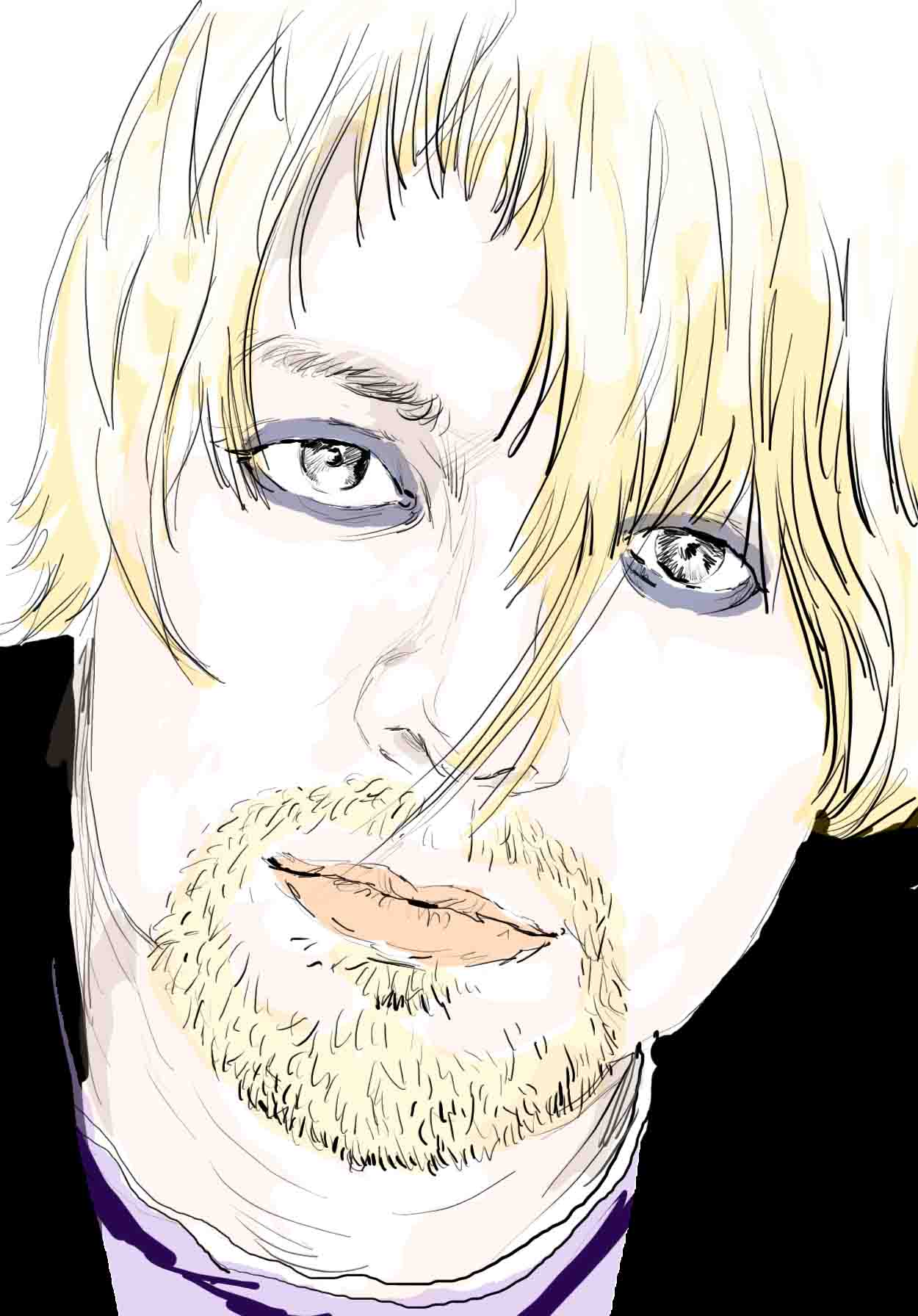
Aberdeen
Cobain was born in February 1967 in Aberdeen, Washington, a logging town he would spend his adult life escaping and writing about. By every account he was a sunny, hyperactive, intensely creative small child. Then, when he was nine, his parents divorced — and something in him closed.
He later described that year as the one that broke him, and the adults around him agreed that he was never the same afterwards. He was shuffled between his mother, his father, grandparents, aunts and uncles, and eventually friends' sofas. He was prescribed Ritalin as a child for hyperactivity, an early sign of a nervous system that ran differently. He found punk rock, and it gave the anger somewhere to go.
Two things followed him out of Aberdeen. The first was a stomach condition — a chronic, undiagnosed burning pain that doctors repeatedly failed to explain and that he described as feeling like being stabbed daily. The second was a family history of mental illness that he was entirely aware of, and that frightened him.
The Family History
Bipolar disorder was present on Cobain's father's side of the family, and two of his great-uncles died by suicide. This was not a secret in the family; Cobain knew, and he spoke about it. The knowledge appears to have shaped how he interpreted his own moods — not as something treatable, but as something inherited and fixed.
The genetics here are real but often overstated in retellings. Bipolar disorder is one of the most heritable psychiatric conditions, and having a close relative with it meaningfully raises risk. It does not make the illness inevitable, and crucially it says nothing at all about how well someone responds to treatment. Many people with strong family histories do extremely well on the right medication. Cobain, tragically, seems to have absorbed the fatalism without the second half of the message.
Nevermind
Nirvana formed in 1987 with Cobain and bassist Krist Novoselic; Dave Grohl joined on drums in 1990. Their debut Bleach came out on Sub Pop in 1989 for a famously tiny recording budget. Then, in September 1991, came Nevermind.
It sold tens of millions of copies, displaced Michael Jackson from the top of the American charts, and ended the reign of hair metal essentially overnight. "Smells Like Teen Spirit" became the anthem of a generation that Cobain neither wanted to lead nor believed in. In Utero followed in 1993, deliberately harsher, an album that read to many listeners as an attempt to shake off the audience he had accidentally acquired.
Fame magnified everything. Cobain despised being a spokesman, distrusted the industry that had made him rich, and found the scrutiny of his marriage to Courtney Love unbearable. He was also, by this point, using heroin heavily — by his own account, initially to dull the stomach pain that no doctor had been able to fix.
The Diagnosis
Cobain was reportedly diagnosed with bipolar disorder, and biographers and family members have described him as having been prescribed lithium at points in his adult life. He did not stay on it.
The reasons he gave will be familiar to many readers of this site: that medication dulled him, that it took something from his writing, that he preferred the extremes to the flatness. It is one of the most common and most dangerous misconceptions about treating bipolar disorder — and it is worth stating clearly that modern practice regards a mood stabiliser that flattens creativity as a dosing or drug-selection problem to be solved, not a permanent trade-off to be accepted.
Layered on top were two things that make bipolar disorder far harder to treat: opioid addiction, and chronic untreated pain. Each worsens the other. Heroin also does a convincing short-term impression of a treatment, which is precisely what makes it so effective at delaying real one.
1994
In March 1994, in Rome, Cobain was hospitalised after overdosing on a combination of prescription sedatives and alcohol; he survived. Days later his family staged an intervention, and he entered a treatment facility in Los Angeles. He left after two days.
He died by suicide at his Seattle home in early April 1994, at the age of twenty-seven. He left behind his wife and a nineteen-month-old daughter.
We are not going to reconstruct the details of his death here, and we would encourage readers to treat any account that dwells on them with suspicion about its motives. What matters for this site is the sequence: a heritable mood disorder, a diagnosis he did not accept, medication he did not continue, an addiction nobody could interrupt, and pain nobody diagnosed — over roughly a decade, with no sustained treatment at any point.
Legacy
Nirvana were inducted into the Rock and Roll Hall of Fame in 2014, in their first year of eligibility. Nevermind remains one of the most consequential albums ever released, and Cobain's songwriting — melodic, self-lacerating, structurally simple and emotionally enormous — still sets the template for guitar music thirty years on.
His mother said something after his death that has stayed with people ever since: that he had joined that stupid club, meaning the musicians who died at twenty-seven. She had begged him not to.
Cobain's story is the most widely known bipolar narrative in modern music, and it is the one most often told fatalistically — as though the illness and the ending were the same thing. They are not. Bipolar disorder is treatable. Compare his story with Patty Duke's, or Stephen Fry's, or Kay Redfield Jamison's: same illness, decades of life, treatment that held.
If you are struggling right now, please reach out. Speak to your doctor, a mental health professional, or a crisis line in your country — and if you are in immediate danger, contact your local emergency services. Bipolar disorder responds to treatment, and the depressive phase always lies about that.
Frequently Asked Questions
Was Kurt Cobain diagnosed with bipolar disorder?
Cobain was reportedly diagnosed with bipolar disorder, and biographers and family members have described him being prescribed lithium. He did not remain on medication, saying he felt it dulled him creatively.
Did bipolar disorder run in Kurt Cobain's family?
Yes. Bipolar disorder was documented on his father's side of the family, and two of his great-uncles died by suicide. Cobain was aware of this history and spoke about it.
What was Kurt Cobain's stomach problem?
Cobain suffered from a chronic, severe burning stomach pain that doctors repeatedly failed to diagnose during his lifetime. He said it was a major reason he began using heroin, which temporarily relieved it. Untreated chronic pain is a well-recognised complicating factor in both mood disorders and addiction.
Notes & sources
This article draws on published Cobain biographies, interviews given by Cobain, Krist Novoselic and family members, and contemporaneous reporting on Nirvana's career and Cobain's 1994 hospitalisation and death. Details of the manner of his death are deliberately omitted in line with international guidance on responsible reporting of suicide.