Beethoven is the oldest case on this website with a genuinely rich documentary record. He wrote thousands of letters. His friends kept diaries. Because he went deaf, visitors had to write their side of conversations down — leaving historians with something close to a transcript of his daily life.
What that record shows is a man who worked in ferocious, sleepless bursts of creative euphoria, then disappeared for weeks into a despair so total that he wrote about wanting to die. Musicologists and psychiatrists have been arguing about what to call that pattern for over a century.
Quick facts
- Born
- Baptised December 17, 1770, Bonn
- Died
- March 26, 1827, Vienna, aged 56
- Known for
- Nine symphonies, 32 piano sonatas, and the invention of the Romantic era
- Diagnosis
- None — retrospective; the most cited historical case of bipolar disorder in music
- Complicating factor
- Progressive deafness from his late twenties
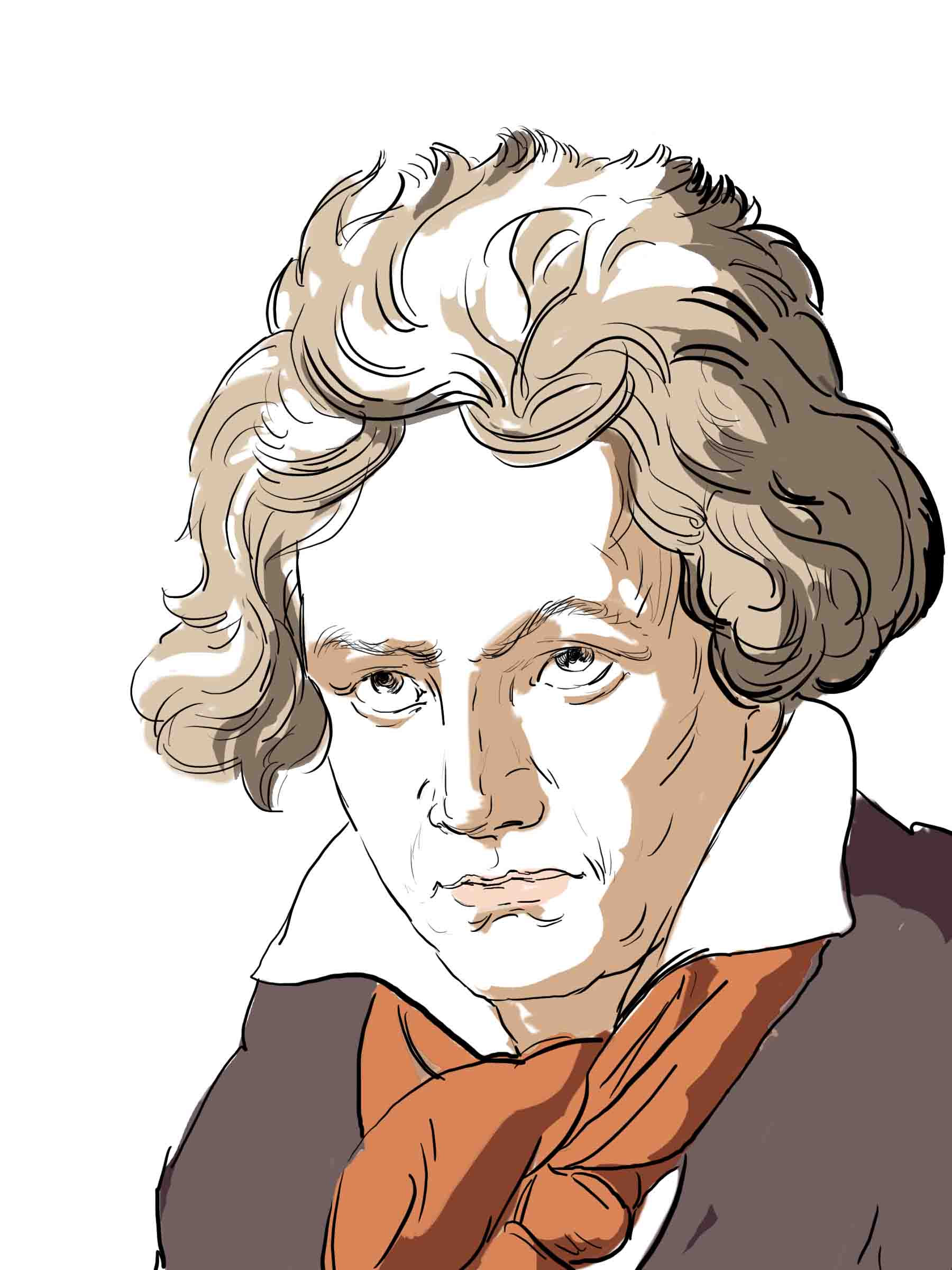
Bonn: A Brutal Apprenticeship
Beethoven was born in Bonn in 1770 to a family of court musicians. His father Johann, a tenor with a drinking problem and an eye on the Mozart family's success, decided his son would be a prodigy and set about producing one. Contemporary accounts describe a small boy dragged from bed at night to practise, beaten for mistakes, and displayed publicly with his age misrepresented to make him seem more remarkable.
By his teens Beethoven was effectively supporting the household. His mother died when he was sixteen; his father's alcoholism worsened until Ludwig petitioned to have half of Johann's salary paid directly to him so the family could eat. He was granted it at nineteen.
In 1792 he left for Vienna to study with Haydn, and never returned to Bonn.
The Moods His Friends Recorded
What makes Beethoven's case unusually strong is that we are not relying on legend. The people around him described his moods repeatedly and independently.
They wrote about periods when he was seized by work — composing at enormous speed, barely eating, walking for hours in all weather muttering and scribbling in notebooks, sometimes not sleeping, filling manuscript paper faster than copyists could keep up. When paper ran out, he wrote on whatever surface was to hand. He would be exuberant, expansive, wildly funny, quick to grand plans and grander promises.
Then it would reverse. Friends recorded weeks in which he saw no one, could not work, believed his talent had abandoned him, and spoke of death. His housekeeping collapsed. He moved lodgings constantly — he is documented in dozens of Viennese apartments — quarrelled violently with patrons and friends, and afterwards wrote extraordinary, remorseful letters of apology.
One well-known account from a contemporary described him as composing, or being unable to compose, according to whether he was in a state of happiness, vexation or sorrow. That is a nineteenth-century observer describing, without the vocabulary, something that looks very like mood-driven functioning.
The Heiligenstadt Testament
In 1802, at thirty-one, Beethoven spent a summer in the village of Heiligenstadt on his doctor's advice. There he wrote a document addressed to his brothers that he never sent and never destroyed. It was found among his papers after his death.
In it he described his despair at his advancing deafness, his humiliation at having to withdraw from company, and his contemplation of ending his life — and then his decision to continue, because he felt the work in him was not finished. It is one of the most affecting documents in the history of music.
The Testament matters to the bipolar question in a complicated way. It gives us Beethoven's own account of a profound depressive episode, in his own hand. But it also gives that episode an obvious external cause: a composer losing his hearing. Deafness is more than sufficient to explain despair. What it does not explain are the elevated periods, which pre-dated the deafness and continued after he had adapted to it.
Composing Through It
The extraordinary thing is what the mood cycles did not stop. In the decade after Heiligenstadt, Beethoven produced the Third, Fourth, Fifth, Sixth and Seventh Symphonies, the Appassionata and Waldstein sonatas, the Violin Concerto, and Fidelio. The Ninth Symphony — premiered when he was profoundly deaf and had to be turned around to see the audience applauding — came in 1824, three years before his death.
His late string quartets, written in his final years amid worsening illness, isolation and a devastating custody battle over his nephew, are still regarded as among the most formally radical music ever written.
So Was Beethoven Bipolar?
Retrospective diagnosis across two centuries is guesswork, and honest historians say so. Beethoven cannot be examined, and the vocabulary his contemporaries used was not clinical.
The case in favour is that the documentary record describes, repeatedly and from multiple independent witnesses, sustained periods of elevated mood, reduced sleep, grandiosity, irritability and enormous productivity, alternating with prolonged episodes of incapacitating depression and suicidal thinking. That is the shape of bipolar disorder, and it is documented across decades rather than in isolated incidents.
The case against is that Beethoven's life supplied ample reason for misery without any illness at all: a violent childhood, progressive deafness in the one sense his profession required, chronic abdominal pain, liver disease, and repeated romantic disappointment. Some scholars also argue that lead poisoning — suggested by analysis of his hair and skull fragments — may account for both his physical symptoms and his irritability.
The most defensible position is the modest one: Beethoven's documented pattern is strongly consistent with bipolar disorder, it is far from the only explanation, and certainty is not available.
Legacy
Beethoven bridged the Classical and Romantic eras almost single-handedly, and in doing so he changed what a composer was allowed to be — not a servant supplying music to a court, but an individual expressing an interior life. That shift is why so much subsequent Western art assumes that intense feeling and great work belong together.
That assumption has a cost, and this website exists partly to complicate it. Beethoven did not compose the Ninth Symphony because he suffered; he composed it despite suffering, in the working intervals between episodes that repeatedly stopped him. The romance of the tortured genius has done real harm to real people by suggesting that treatment costs you your gift. It is worth remembering that Beethoven himself, in Heiligenstadt, described his condition as the thing standing between him and his work.
Frequently Asked Questions
Was Beethoven diagnosed with bipolar disorder?
No. Beethoven died in 1827, long before bipolar disorder was defined. Any suggestion that he had the condition is a retrospective interpretation of letters, diaries and contemporary accounts, not a medical diagnosis.
What evidence suggests Beethoven had bipolar disorder?
Contemporaries repeatedly described alternating states: periods of sleepless, euphoric, extraordinarily rapid composition, and prolonged periods of despair in which he could not work at all and wrote about wanting to die. The Heiligenstadt Testament of 1802 is his own written account of a severe depressive episode.
Did Beethoven's deafness cause his depression?
It certainly contributed, and the Heiligenstadt Testament makes that explicit. But his mood swings were noted before his hearing loss became severe and continued after he had adapted to it, which is why historians treat deafness as a major complicating factor rather than a complete explanation.
Notes & sources
This article draws on Beethoven's surviving correspondence, the Heiligenstadt Testament, the conversation books kept during his deafness, and accounts by contemporaries including Wegeler and Ries. Modern scholarship on lead exposure and his physical health is also reflected. No medical diagnosis of Beethoven exists or can be made.