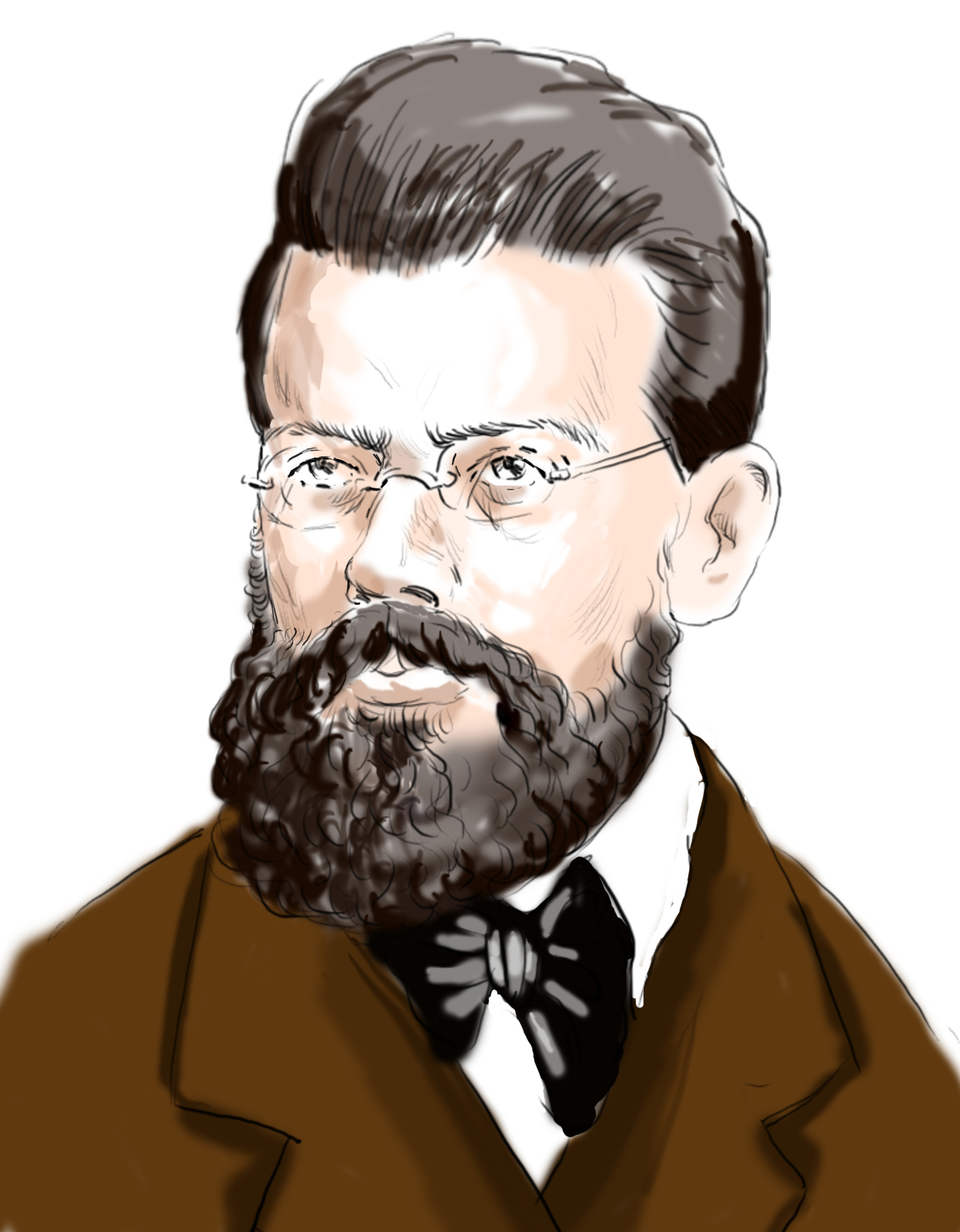
Ludwig Boltzmann worked out that the behaviour of gases, the direction of time and the nature of entropy could be explained statistically, by treating matter as made of enormous numbers of atoms. He was right about all of it, and he spent the last twenty years of his life being told by eminent colleagues that atoms did not exist.
His mood swings were noted by scientists across Europe, and he joked about them himself. He is one of the more credible historical cases on this website.
Quick facts
- Born
- February 20, 1844, Vienna, Austria
- Died
- September 5, 1906, Duino, near Trieste, aged 62
- Known for
- Statistical mechanics; the Boltzmann constant; the entropy formula on his gravestone
- Diagnosis
- None — retrospective, but unusually well supported by contemporary accounts
- His own words
- He attributed his swings to having been born between Shrove Tuesday and Ash Wednesday
The Physics
Boltzmann's achievement is foundational. He gave a statistical explanation of the second law of thermodynamics, showing that entropy increases because disordered states are overwhelmingly more probable than ordered ones — which means the arrow of time itself is a statistical phenomenon.
His entropy equation, relating entropy to the logarithm of the number of possible microscopic arrangements, is carved on his gravestone in Vienna's Central Cemetery.
He held chairs at Graz, Vienna, Munich and Leipzig, moving frequently — a restlessness that is itself sometimes cited as evidence of his temperament.
Twenty Years of Being Told He Was Wrong
The intellectual context matters enormously to any assessment of his mental state.
In the late nineteenth century the existence of atoms was genuinely contested. An influential school — the energeticists, led by Wilhelm Ostwald, with philosophical support from Ernst Mach — held that science should confine itself to observable quantities and that unobservable atoms were an illegitimate hypothesis.
Boltzmann's entire life's work rested on atoms being real. He spent decades in public disputation defending it, and he described himself at one point as a man fighting alone against the current.
He was largely vindicated within a few years of his death: Einstein's 1905 paper on Brownian motion and Perrin's subsequent experiments settled the question definitively in favour of atoms.
The Mood Evidence
Contemporary accounts describe Boltzmann alternating between exuberant, sociable, extraordinarily productive periods and episodes of severe despondency, anxiety and inability to work. Colleagues and students noted it; so did his family.
He made a joke about it that has become the standard quotation in every account of him: that his rapid swings between happiness and sadness were explained by his having been born on the night between Shrove Tuesday and Ash Wednesday — the boundary between carnival and Lent. It is a good joke, and it is also a man describing his own cyclical mood with complete accuracy.
In his final years the depressive periods deepened. He suffered from severe headaches, asthma, worsening eyesight that threatened his ability to read, and anxiety about his teaching. He attempted suicide at least once before his death.
He died in September 1906 at Duino, near Trieste, while on holiday with his family; his death was by suicide. His wife and daughter had gone swimming.
If you're struggling, please reach out. A doctor, a mental health professional, or a crisis line in your country — and emergency services if you're in immediate danger.
So Was Boltzmann Bipolar?
Reasonably plausible, and better supported than most historical cases here.
In favour: multiple independent contemporary observers describing cyclical alternation between elevated, highly productive periods and incapacitating depression, sustained across decades rather than concentrated in one crisis; his own recognition of the pattern; and a family history that some accounts suggest included similar difficulties.
Against, or complicating: he had real physical illness in later life, real professional persecution, and real fear about losing his sight. Any of those would depress anyone. The romantic version of his story — that he died because the scientific establishment rejected his atoms — is almost certainly too neat, and rather insulting to a man with a documented long-standing illness.
Our reading is that Boltzmann probably had a cyclical mood disorder, that his final years combined it with severe physical illness and professional isolation, and that the standard tragic narrative flattens something more complicated.
Legacy
Boltzmann's statistical mechanics underpins modern physics and chemistry. The Boltzmann constant is one of the fundamental constants of nature, now used in the definition of the kelvin.
His gravestone carries his entropy formula, which is as good a monument as any scientist has received.
The lesson we would draw is the one his story usually obscures: he was not killed by his critics. He was a man with what appears to have been a serious recurrent illness, at a time when nothing whatever could be done for it, who also happened to be under enormous professional strain. Both things are true, and the illness deserves naming rather than being folded into the martyrdom.
Frequently Asked Questions
Was Ludwig Boltzmann bipolar?
There is no diagnosis, but the retrospective case is reasonably strong. Multiple independent contemporary accounts describe cyclical alternation between exuberant, highly productive periods and incapacitating depression across decades, and Boltzmann joked about the pattern himself.
Did Boltzmann die because scientists rejected his work?
That is the romantic version and it is too neat. He faced genuine and prolonged opposition to atomic theory, but he also had a long-standing pattern of mood swings, severe physical illness including headaches, asthma and failing eyesight, and had attempted suicide previously. The professional isolation was one factor among several.
What is Boltzmann's entropy formula?
It relates the entropy of a system to the logarithm of the number of possible microscopic arrangements consistent with its observable state, showing that entropy increases because disordered configurations are overwhelmingly more probable. It is carved on his gravestone in Vienna.
Notes & sources
This article draws on contemporary accounts by Boltzmann's colleagues and students, his own published remarks, and historical scholarship on the atomism debate and on his final years.