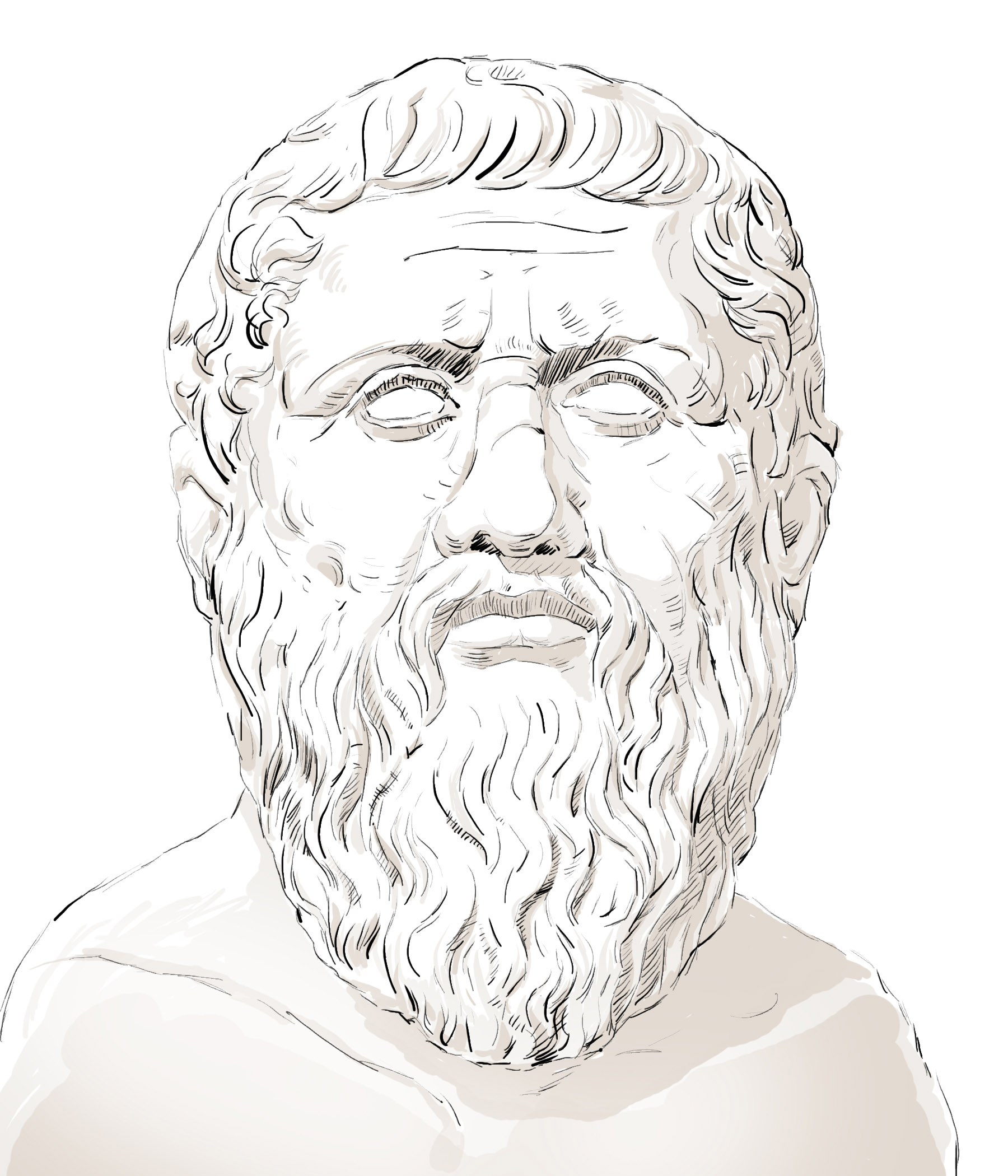
Let us be clear at the top: there is no evidence that Plato had bipolar disorder, and there could not be. He died around 348 BC. We have his writing, a handful of possibly authentic letters, and secondhand accounts written centuries later. Nothing about his moods, his sleep or his behaviour survives in any usable form.
He is on this website for a different and better reason. Plato wrote the argument that this entire site is an examination of — the claim that certain kinds of madness are not defects but gifts — and everything written since about creativity and mental illness is a footnote to what he said in the Phaedrus.
Quick facts
- Born
- c. 428 BC, Athens
- Died
- c. 348 BC, Athens, aged around 80
- Known for
- The Republic, Phaedrus, Symposium; founder of the Academy
- Diagnosis
- None, and no evidence of any kind
- Why he's here
- He wrote the original argument linking "divine madness" to creativity
The Four Kinds of Divine Madness
In the Phaedrus, Plato has Socrates make an argument that was startling then and remains influential now: that the greatest goods come to us through madness, when it is given as a divine gift.
He distinguishes four kinds. Prophetic madness, associated with Apollo. Ritual or purificatory madness, associated with Dionysus. Poetic madness, given by the Muses — and here Socrates says that anyone who approaches the doors of poetry through skill alone, without this madness, will produce nothing worth having. And erotic madness, the highest kind, associated with Aphrodite and Eros, which draws the soul toward beauty and truth.
The crucial move is that Plato distinguishes this divine madness from ordinary human illness. He is not saying that being unwell makes you a poet. He is saying that inspiration involves a state that is not rational, not chosen, and not under the control of the person experiencing it — that it comes from outside and takes you over.
Aristotle later gave the idea a more clinical turn, asking in the Problems why it is that all men who are outstanding in philosophy, poetry or the arts appear to be melancholic. That question, twenty-three centuries old, is essentially the research question Kay Redfield Jamison set out to answer in Touched with Fire.
What We Inherited
The Platonic idea has been extraordinarily durable, and it has been both useful and harmful.
Useful, because it insists that unusual mental states can be generative rather than merely defective, and because it has given a great many people a way to think about their own minds that is not purely pathological. There is also, as Jamison's work demonstrates, a real statistical association between mood disorders and creative achievement, particularly in poetry. Plato was not simply wrong.
Harmful, because the idea has hardened into the tortured-genius myth — the belief that suffering is the price of art and that treating an illness will cost you your gift. That belief appears repeatedly on this website in the mouths of people it damaged: Axl Rose, Kurt Cobain, Adam Ant, and Jamison herself before she stayed on lithium.
It is worth noticing that Plato does not actually say the harmful version. He describes a temporary state of inspired possession, not a chronic illness, and he does not suggest that anyone should refuse to be cured of anything.
The Man
What little we know: he was born into an aristocratic Athenian family around 428 BC, became a follower of Socrates, and was profoundly affected by Socrates' execution by the Athenian state in 399 BC. He travelled, involved himself unsuccessfully in the politics of Syracuse, and founded the Academy in Athens — arguably the first university in the Western tradition, which operated for some nine hundred years.
He wrote in dialogue form, almost always with Socrates as a character, which makes it genuinely difficult to determine which views are his own. He shaped essentially every subsequent question in Western philosophy.
Nothing in any of this bears on his mental health, and anyone who tells you otherwise is inventing.
Why Keep This Page
Because Plato appears on lists of famous bipolar people, and readers who find him there deserve to be told that the claim is baseless, and then to be told the far more interesting thing that is actually true.
The question of whether extraordinary minds are disproportionately touched by mood disorders is not a modern internet listicle. It is one of the oldest questions in Western thought, and it was asked first here, in a dialogue about love and rhetoric written by a man walking around Athens in the fourth century BC.
Every biography on this website is an attempt to answer it about one particular person. Plato is the one who asked.
Frequently Asked Questions
Was Plato bipolar?
There is no evidence whatsoever, and none could exist. Plato died around 348 BC and nothing survives about his moods, sleep or behaviour. Any claim that he had bipolar disorder is invention.
What did Plato say about madness and creativity?
In the Phaedrus he argued that the greatest goods come through madness when it is a divine gift, distinguishing four kinds: prophetic, ritual, poetic and erotic. He held that poetry produced by skill alone, without this inspired state, would be worthless. Crucially, he distinguished this divine madness from ordinary human illness.
Who first linked genius and melancholy?
Plato made the argument about divine madness and inspiration in the Phaedrus. Aristotle gave it a more clinical form in the Problems, asking why outstanding figures in philosophy, poetry and the arts appear to be melancholic - essentially the research question modern scholars including Kay Redfield Jamison have investigated.
Notes & sources
This article draws on Plato's Phaedrus, the Aristotelian Problems, and standard scholarship on Plato's biography. No evidence exists regarding Plato's mental health and this page does not claim otherwise.