Vincent van Gogh produced around nine hundred paintings and more than a thousand drawings in a working life of about ten years. He sold very few in his lifetime. He died at thirty-seven.
He is the most-diagnosed dead man in the history of art. Bipolar disorder, epilepsy, schizophrenia, borderline personality disorder, acute intermittent porphyria, lead poisoning, syphilis, absinthe toxicity and Ménière's disease have all been proposed, some of them by serious clinicians. The honest answer is that we do not know, and the reasons we do not know are themselves worth understanding.
Quick facts
- Born
- March 30, 1853, Zundert, Netherlands
- Died
- July 29, 1890, Auvers-sur-Oise, France, aged 37
- Known for
- The Starry Night, Sunflowers, and roughly 900 paintings in ten years
- Diagnosis
- None settled — at least a dozen have been proposed, including bipolar disorder
- Evidence
- Roughly 900 surviving letters, plus asylum records from Saint-Rémy
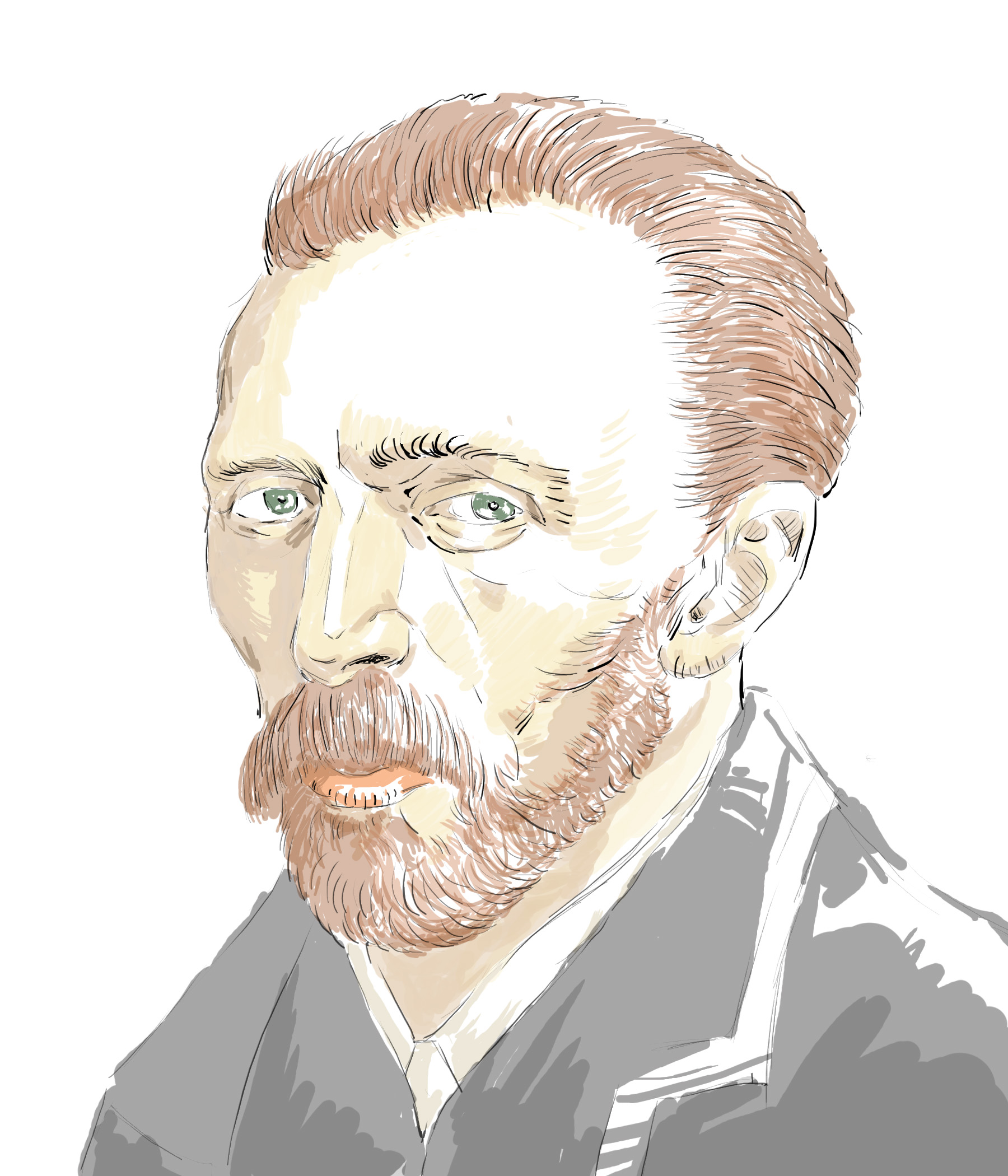
Ten Years of Failing
Van Gogh was born in the southern Netherlands in 1853, the son of a pastor. Before he became a painter he failed at almost everything he attempted, and the pattern is striking: he threw himself into each with total, consuming intensity, and each ended in collapse.
He worked as an art dealer and was dismissed. He trained as a teacher in England. He attempted to become a pastor, failed the entrance examinations, and went instead as a lay missionary to a mining district in Belgium — where he gave away his possessions, slept on straw and lived in conditions so extreme that the church authorities dismissed him for excessive zeal.
He was rejected repeatedly and painfully in love. He quarrelled with nearly everyone. He was, by his family's accounts, exhausting.
He decided to become an artist at twenty-seven. He had ten years left.
The Letters
What makes Van Gogh's case unusually rich is that roughly nine hundred of his letters survive, most to his brother Theo, who supported him financially for a decade.
They show a man of considerable intelligence, wide reading and complete lucidity for most of the time — discussing colour theory, Japanese prints, Zola, Dickens and the technical problems of painting with precision and self-awareness.
They also show the pattern that supports a mood-disorder reading. There are periods of enormous, almost frightening productivity: he wrote of working from dawn until dark, of finishing a canvas a day, of an urgency he could not slow down. In Arles in 1888 he produced some two hundred paintings in about fifteen months.
And there are periods of total collapse, in which he could not paint, described himself as worthless, and wrote about the futility of continuing.
Crucially, he also described his own episodes from the inside with remarkable clarity once they had passed — the confusion, the terror, the not knowing what he had done.
Arles, and the Ear
In February 1888 Van Gogh moved to Arles, hoping to establish an artists' colony. Gauguin came in October. They worked together intensely and quarrelled bitterly, and on 23 December 1888, following a confrontation, Van Gogh cut off part of his own ear.
He was hospitalised, and in May 1889 admitted himself voluntarily to the asylum at Saint-Rémy-de-Provence, where he remained for a year. The medical records from Saint-Rémy survive in part. The physician there recorded episodes involving hallucinations, confusion and severe agitation lasting days to weeks, separated by intervals of complete lucidity.
The attending doctor's diagnosis was a form of epilepsy — specifically what would now be described as temporal lobe seizures. This was a serious contemporary judgement by a physician who observed him directly over a year, and it deserves more weight than it usually gets.
During that same year, in that asylum, he painted The Starry Night.
Why So Many Diagnoses?
The competing explanations each capture part of the picture, which is exactly why none has won.
Bipolar disorder accounts well for the alternation between prolonged, hugely productive elevated periods and profound depressive collapse, and for the pattern visible in the letters across his whole adult life, not just his final years.
Temporal lobe epilepsy was the contemporaneous diagnosis by the doctor who observed him, and accounts for the discrete episodes of confusion and hallucination with clear intervals between.
Toxic and metabolic causes have serious advocates. He drank absinthe heavily; he was exposed to lead in his paints and, by some accounts, occasionally ingested them; and acute intermittent porphyria has been proposed to explain the combination of abdominal symptoms, neurological episodes and psychiatric features. Malnutrition was documented — he frequently spent Theo's money on paint rather than food.
Personality and trauma factors are also real: repeated rejection, financial dependence and profound isolation.
The most likely truth is that several of these were operating at once. A man with an underlying mood disorder, drinking heavily, malnourished, exposed to lead, and under sustained psychological strain does not present as a textbook case of anything.
Auvers, 1890
Van Gogh left the asylum in May 1890 and moved to Auvers-sur-Oise, under the informal care of Dr Paul Gachet. He painted prolifically — around seventy canvases in seventy days.
On 27 July 1890 he sustained a gunshot wound to the abdomen in a field outside the village. He walked back to his lodgings and died two days later, aged thirty-seven, with Theo present.
The account has always been that it was self-inflicted. A minority scholarly view, argued in a substantial 2011 biography, holds that he may have been shot accidentally by local boys and chose to protect them. The evidence is genuinely disputed and we would not present either version as settled.
Theo died six months later.
If you're struggling, please reach out. A doctor, a mental health professional, or a crisis line in your country — and emergency services if you're in immediate danger.
The Myth We Should Stop Repeating
Van Gogh is the founding text of the tortured-genius myth, and the myth gets him almost exactly backwards.
He did not paint during his episodes. He painted in the intervals between them, and he said so repeatedly and with obvious frustration. His letters from Saint-Rémy are full of a man begging to be well enough to work — describing the attacks as thieves that took weeks from him.
He was also a highly disciplined technician. He studied colour theory systematically, drew relentlessly to improve, analysed other painters' methods, and worked with a rigour that has nothing to do with inspired madness. The reason The Starry Night works is that a man who had spent a decade teaching himself to paint knew exactly what he was doing with that brush.
The illness did not give him the paintings. It cost him the time in which he might have made more, and then it killed him at thirty-seven.
Legacy
Van Gogh sold almost nothing in his lifetime and depended entirely on his brother. His work is now among the most valuable and most reproduced in the world, and the Van Gogh Museum in Amsterdam holds the largest collection.
His posthumous reputation was largely built by Theo's widow Johanna van Gogh-Bonger, who inherited the paintings and the letters, spent decades organising exhibitions and publishing the correspondence, and is the reason we know him at all.
For readers here, the most useful thing about Van Gogh is not the ear or the myth. It is the letters — nine hundred documents in which a man with a serious mental illness describes his own experience with precision, insight and humour, in between the episodes that were taking his life apart. Almost nobody in the nineteenth century left a record like that, and it is worth reading in his own words rather than through the legend.
Frequently Asked Questions
Did Van Gogh have bipolar disorder?
It is one of at least a dozen diagnoses proposed, and it accounts well for the alternation between long, hugely productive periods and profound depressive collapse visible across his letters. However, the doctor who observed him for a year at Saint-Remy diagnosed a form of epilepsy, and toxic, nutritional and metabolic explanations also have serious support. No diagnosis is settled.
Why did Van Gogh cut off his ear?
He cut off part of his ear on 23 December 1888 following a bitter confrontation with Paul Gauguin in Arles, during what appears to have been an acute episode. He was hospitalised afterwards and later admitted himself voluntarily to the asylum at Saint-Remy.
Did Van Gogh paint during his episodes?
No, and this is the most misunderstood thing about him. He painted in the intervals between episodes, and his letters repeatedly describe the attacks as stealing working time from him. The idea that his illness produced his art reverses what he himself described.
Notes & sources
This article draws on Van Gogh's surviving correspondence, the surviving medical records from the asylum at Saint-Remy, and modern scholarship on the competing diagnostic explanations and on the circumstances of his death, including the disputed accidental-shooting hypothesis.